
The Teensy 3.2 is a complete USB-based microcontroller development system in a very small footprint. Teensy boards have been used in many types of projects — musical instruments, interactive installations, and electronic arts and crafts. All programming is done via USB through the Arduino IDE (Integrated Development Environment). Here is the Teensy 3.2 product page if you are interested in a more thorough explanation of the Teensy ecosystem.
When you upload the supplied code to the Teensy, it will become a class compliant MIDI controller — allowing you to communicate back and forth with a computer in a range of ways. Without changing the code, the Teensy 3.2 will be able to accept 4 analog inputs (sliders, knobs. etc), 10 digital inputs (buttons, toggles), and 4 capacitance inputs (touch magic). The Teensy will also be able to send to 5 digital outputs to control LEDs and small motors. You can modify the code to accept up to 10 analog inputs, 23 digital inputs or outputs, and/or 9 touch/capacitance inputs — allowing you to alter/expand the code to suit your specific ideas. The pinout diagram below shows each pin and the various functions it can perform.
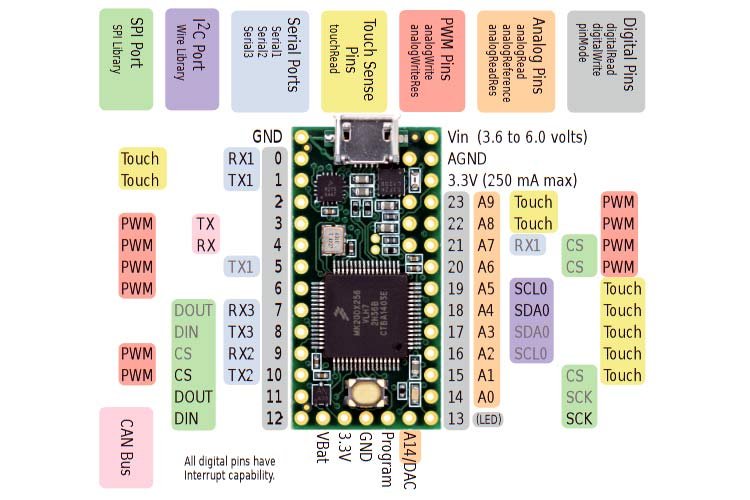
In the diagram above, there are a maximum of 23 digital pins, 10 analog pins, 9 touch pins, and 10 PWM (pulse width modulation) pins. You can choose to use different pins combinations based on the needs of your project. For example, you might build a sculpture with 22 toggle switches, so most of your pins will be digital inputs (which are either on or off, 1 or 0. If you used conductive thread and temperature sensors in a scarf, you might want more touch pins (which sense capacitance, or touch) and analog pins (which expect a range of values, like a changing temperature, 0-127 / continuous MIDI data).