There are many different kinds of analog sensors. To find sensors that work right away with this system, look for analog sensors that have 3 connections: Power (sometimes called + or VCC or VDD), Ground (sometimes called GND or – or 0V), and Signal (sometimes called S). As long as the sensor has those pins, you connect it in the same way you connect any analog sensor. Also, make sure that the sensor works with the output voltage of the Arduino you are using. If you are using the Pro Micro, it needs to work with 3.3v.
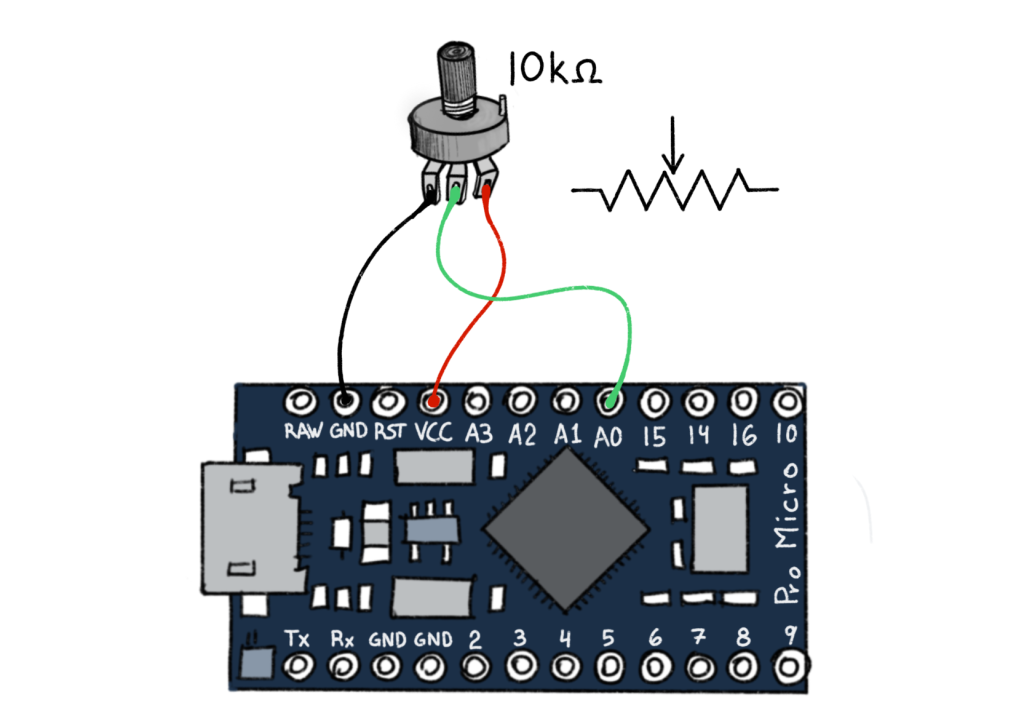
Connect the Power to a VCC pin on the arduino. Connect ground to a GND pin on the arduino. Connect the signal pin to whichever Analog input pin you are using.
There are other types of sensors that only have 2 pins or legs, like photocells, FSRs (force sensitive resistors) and bend sensors. These sensors require an extra resistor (usually 10KΩ) from the signal leg to ground.

On the left, the signal leg that connects to pin A0 on the arduino is also connected to ground on the arduino, but through a 220 Ohm resistor (see image). This creates the ground connection, like with the 3 pin analog sensors above.
Sensors
Here are a few types of sensors that will work well with the animating interfaces / tricorder system. There are many other types of analog sensors that would work as well, but they would require more substantial changes to the code.
Three Pin Sensors
3‑Axis Analog Accelerometer Module: A 3-axis analog accelerometer module, works with 3.3 V. Good for sensing motion/orientation.
Soil Moisture Sensor (3.3‑5.5 V): A soil moisture sensor with a 3-pin analog interface. Rated for 3.3-5.5v
Temperature module (using the TMP36 or equivalent). works fine at 3.3 V.
Analog Hall Magnetic Sensor Module: A Hall effect sensor module with analog output; good for magnetic field sensing; be sure to check compatibility with 3.3 V.
Piezo Vibration Sensor Module (3.3/5 V): A piezo-vibration or shock sensor module; analog output.
Sound Sensor Module (3.3‑5 V): Another variant of sound-level analog sensor.
Distance sensor – using IR pulses. Measures distance. You can get these to measure different distance ranges.
Two Pin Sensors (these need an additional resistor connected to ground)
FSR (force-sensitive resistor) – Detects pressure or touch force
Flex sensor – Detects bend or flex angle
LDR – Light Sensor